- Basic Counting:
- One of the most obvious questions is how musicians know when to play. Well, its easy.. they learn to count the beats.
- First let us present you with this.
- 1 whole note = 2 half notes = 4 quarter notes = 8 eighth notes = 16 sixteenth notes.
Keep that in mind while looking at these examples.

First off, looking at the time signature you know that there are 4 quarter notes per measure.
In the first measure the whole note gets all the beats (1, 2, 3 and 4) because 1 whole note = 4 quarter notes, and there are a total of 4 quarter notes per measure.
In the second example, each half note gets 2 beats because 2 quarter notes = 1 half note.
In the third example, each quarter note gets its own beat because there are 4 quarter notes per measure (time sig).
Let's intermingle the 2 quarter notes and a half note.
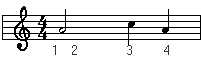
The half note get the first 2 beats, and each quarter its own beat. This makes sense because the 4/4 time signature means there is 4 quarter notes per measure. 2 quarter notes + 1 half note (which is really 2 quarters) = 4 quarter notes, the total number of quarter notes for that measure (time sig).
Lets add in the eighth notes.
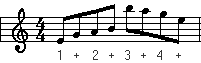
In this example there is something new. The + sign. It just means "and". If you said 1 + 2 + ... out loud it would sound like this.
1 and 2 and 3 and 4 and
Each eight note is 1/2 of a quarter note, therefore it takes 2 eighth notes to equal 1 quarter note.
Think of it like this: the 1 and the "and" are both half of one quarter note and together they form 1 quarter note and from the time sig we know there are 4 quarters per measure.
This may seem a little confusing now, but all of the sudden it will click. You will hit yourself in the head and wonder how you never understood it.
